Vaccines to protect us against COVID-19 are expected to arrive in a matter of weeks and before long, we'll all be lining up to get one.
But amid that good news, there are still some unanswered questions about how we will function in a vaccinated society. Tiara Lyons had some of those questions after she gave birth during the pandemic and as she prepared to search for a babysitter. Ideally, the sitter would be someone who had been vaccinated.
"I felt it was too risky for me to simply take the babysitter’s word they were vaccinated, yet also felt it was too invasive to ask a stranger for medical records," she said.
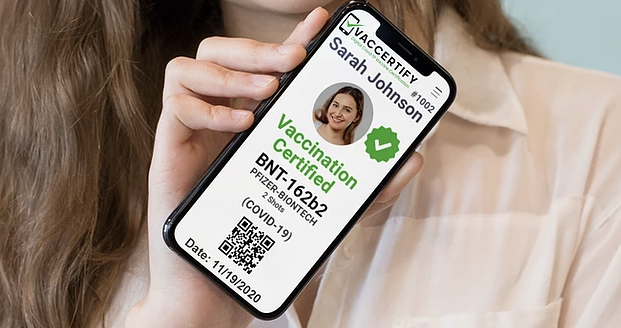
That's when she got the inspiration to create an app that would allow people to share proof of their vaccination certification. Today, Lyons is the founder and CEO of Vaccertify, a Seattle-based start-up that has created a prototype app that is also called Vaccertify.
Once vaccinations are available, users can create a digital certification by uploading their vaccination record, a government-issued identification document and a selfie photo. Vaccertify then creates a ID screen that includes a scannable QR code linked to a profile in the Vaccertify database. The system also uses a private PIN that must be entered in order to view the certificate.
Like Lyons' babysitter concerns, Vaccertify is designed to be used in social or business interactions.
For example, a homeowner might want proof that service providers are vaccinated before allowing them access to their home. A party host might want only vaccinated guests at an event. Visitors to a group home could be screened using Vaccertify. And certification could soon become a connection point for online dating.
The cost to use Vaccertify is $49.99 with the certificate posted in seven days. Users can pay more for faster processing.
For a closer look at the service and to find out when it will be available, visit the Vaccertify website and follow @Vaccertify on Twitter.
I remember when the first fitness wrist bands hit the market. Their instant popularity showed that people wanted to know how many steps they took in a day or how much distance they covered in their daily runs.
But even more attractive was their ability to collect and chart the wearer’s progress. Now they could clearly see that they were running farther than they did on an average day two months ago, or that they tended to ease up on Mondays. The charts and graphs helped them keep their focus on their goal.
That same idea is put to work in an Apple app called Done hat can help people reach goals that go beyond physical fitness.
With Done you can track any habit that you repeat on a regular basis. Let’s say you want to drink more water every day. You create a new habit that you might call Hydrate and maybe set a goal of drinking 12 cups a day.
As you log your daily drinks, Done builds a record of you progress and generates on-demand reports that show how well - or how poorly - you are doing.
And it’s those report cards that really provides an incentive. There’s something about seeing your streak portrayed on a calendar or a chart that reinforces your determination. You get pumped up seeing proof that you really did go to the gym six days in a row. The app can also be used to help break bad habits, like smoking or drinking.
Users can group habits into custom categories, set multiple reminders for each habit, assign color codes and enter notes about each habit. And the app works with the Apple Watch, Siri and Apple’s HealthKit.
The basic version can be downloaded for free from the Apple App Store. A Premium version with additional features is also available. For more details, visit the Done App website or follow @treebetty on Twitter.
Among the many advantages of online shopping is the ability to easily get detailed product information and reviews written by actual users. These days we buy almost nothing without checking the fine print and user opinions.
Now there's a website that provides a similar level of service for people shopping for legal cannabis products in California.
Zencca offers photos and profiles of more than 1,000 cannabis products. Each profile includes a description of the product including its CBD content. Those who have tried cannabis-infused pretzels, for example, can give it a star rating and also rate its effects (was it euphoric? Did it stimulate creativity?) and its physical impact (did it affect your head, body or both?).
The profile page also has a map showing the location of stores that stock the product. Almost all of the stores mapped on Zencca are in Southern California. The site is labelled as a Beta version, so coverage of other area might be in its future.
Visitors who register on the site can also get a Cannabis Profile Assessment that will suggest products that fit your lifestyle and interests. Zencca's privacy statement says the company will not sell or share your information.
The assessment starts with a series of questions about how you spend your time. Do you prefer outdoor activities or do you prefer reading or similar pursuits? Do you use cannabis for health reasons or for artistic stimulation? Would you rather go out on the town socializing or relax at home? What's your potency tolerance level? Do you prefer edibles and other discreet products?
The system will assign you a profile type (I'm a Spartan) and begin displaying products keyed to your profile. Zencca suggested that I might like lemon-flavored cookies, a rub for body pains and a bud described as having "a sweet, heavy aroma that will relax the user with its tasty flavor profile and uplifting effects."
All good suggestions, in my opinion. Unfortunately, I live quite far away from the stores in LA, Escondido and Palm Springs that stock those lemon cookies.
To get a closer look at the site and get your own cannabis profile, check out he video below and visit the Zencca website.
“Nobody’s perfect,” as my mother would frequently remind me. Then she would add, “But don’t let that stop you from trying.”
Over time, I figured out her point: It’s your life, you are in charge, so why not aim high?
For some people, the task of steering their ship of life seems to come without effort. Others, probably most others, could use a little help. Many people have found that help by establishing a routine of daily affirmations - positive expressions of their goals and beliefs.
And, yes, there’s an app for that.
Affirmations is an Android app that helps you set goals and track your progress. Once a day - or more often - the app delivers a reminder of your chosen goal.
When you’re prompted to remember a goal, adherents say you sharpen your focus and program your subconscious mind to continue your quest. Think of it as a daily planner for your brain.
Some people already have a special goal in mind, like losing weight or making new friends. Others set up a program by choosing from a list of self-improvement topics such as Happiness, Health, Prosperity and Finding love.
And some folks just need to reaffirm what they already know - that there is love and joy all around them.
The Affirmations app is available as a free download from the Google Play Store.
People who suffer from persistent neck pain typically turn to pills or lotions for relief. But scientists have discovered that electrical impulses can also be an effective treatment.
Transcutaneous electrical nerve stimulation, often called TENS, is a therapy that applies low voltage electrical current directly to the troublesome areas of the body.
Some researchers believe that the current stimulates nerve cells that block the transmission of pain signals. Others say nerve stimulation increases endorphins, the body’s natural pain-killing chemical.
The people at Necklogia have figured out how to put a TENS delivery system into a portable neck massaging device.
Their original device, the Necklogia Intelligent Neck Massager, has two delivery points positioned to focus on the lower neck area. Users can select among three stimulation modes: one for soothing a neck injury, another for chronic pain, and a third mode for daily use.
A Pro Edition model has two additional delivery disks that put heat and massage on stiff or painful spots on the lower next and shoulder area.
Both models have built-in rechargeable batteries. Both massagers are currently on sale. The Intelligent Neck Massager costs $58.67 and the Pro Edition costs $79.85.
Physical exercise is typically a solitary activity. Unless you're playing team sports, it's just you swimming laps, jogging down the street or straining on the weight machine.
But adding a social component can often pay dividends. If your friends are biking on Tuesday evenings or mall walking on Saturday mornings, you're more likely to show up.
Exercising together can also get your competitive juices flowing, resulting in a longer workout that pushes you closer to your goals.
The inventors of Jabbie recognized the power of group efforts in the pursuit of personal fitness and they built that component into a mobile app that they plan to release. The app will let users get personalized encouragements from a community of users who share similar personal fitness goals.
Jabbie users can set their own fitness activity schedules and set their personal goals and milestones. But they can also join or create a "troupe of support" and schedule workouts with other troupe members.
With group participation, members send and receive encouragements from other members. While that communication happens primarily online, Jabbie members can also use the app to make connections with users nearby in the offline world.
Jabbie's creators are Bunmi Alo, an entrepreneur and software developer who immigrated to the US from Nigeria, and Dr. Joy Cox, a body and social justice advocate. They share the belief that "the accessibility around fitness is a social justice issue" and that their app will provide "a safe space for users to be active regardless of their fitness level or location."
Jabbie is slated to be launched by the end of the year. You can learn more about the plans for Jabbie in the video below and on the Jabbie website. You can hear the creators discuss their philosophy and their plans on the Wellness Lately podcast.
Alo and Cox hope to raise $27,000 to finance the production of the app. Supporters can donate using this PayPal link.
People in Singapore, Taiwan and South Korea have been using digital self-reporting apps that area credited with curbing the spread of Covid-19 in the early stages of the virus outbreak.
The apps allowed government and health authorities to identify and track both people who had a virus infection or symptoms while also tracking anyone they may have come in contact with.
In the US, Apple and Google have announced plans to create a similar tracking system using a mobile phone-based app. While the Apple-Google technology is in its early stages, a private company has released an app called MyTemply that helps track their health status and share it with their school or employer.
With MyTemply, users enter their body temperature using any type of thermometer. They also note other symptoms, such a cough, shortness of breath, headache or chills. Use of the app is voluntary and the data is self-reported. MyTemply doesn't use Bluetooth or GPS and doesn't record or track anyone who comes in contact with the user.
The app is designed to be used every day to report the user's heath to their school, company, hospital, doctor, or family. Managers can get a secure dashboard that collects and organizes the reported data. The information can be shared with some human resources management systems.
Like many people, I thought our decades-old bathroom scale would do just fine to get me through a weight loss program. But I wasn't very good at recording what the scale told me. And, as behavioral science tells us, we all do better in any endeavor when we track our progress.
The Ugramo Fit Pro is a smart scale that's designed to help people reach any sort of fitness goal. Like many smart scales, it will record your weight and log it in a free app. Urgamo provides a free app for Apple or Android phones and it's also compatible with Google Fit, Apple Health and Fitbit.
But the Fit Pro goes well beyond simple weight tracking. It can also check your heart rate, calculate your body mass index, body fat, and other metrics. It has an 4.6-inch LCD display that shows eight different measurements. It has an "Athlete Mode" and a "Baby Mode" and it supports up to 10 different users.
It even calculates body balance. That's something that athletes check, but balance can also be important for older persons, especially women with low bone mass. Knowing the numbers can help with a balance training program.
The Ugramo Fit Pro Smart Body Scale with Heart Care costs $89.95 and is available on the Urgramo website.
Reading food labels is one way to make us healthier eaters and smarter shoppers. But who has the time to digest all those details and the knowledge to understand what we’re reading? Plus, not all labels will tell us what we want to know. Will this meal trigger my food allergy? Does that one contain genetically modified organisms?
A new generation of smart phone apps uses a mobile phone’s scanning ability to drill deep into the contents of packaged foods to deliver more information, in plain language, about what’s really inside. The apps work by scanning the bar code that’s printed on most grocery food and retrieving information from an online database of foods and their ingredients.
Here’s an example. If you use ShopWell to scan the barcode on a package of Healthy Choice Chicken Basil Panini in the frozen food section, the app will tell you that the sandwich is a good source of iron, protein, fiber and calcium but it also has more sugar and sodium than you might want.
ShopWell will also warn you if a packaged meal contains, nuts, shellfish, eggs, soy or other ingredients that might cause an allergic reaction. And it offers alternative choices for many foods such as a breakfast cereal that has less sugar than the in brands you see on television.
Add caption
InRFood also scans a barcodes to see what’s inside the package. Does that pizza contain artificial colors, trans fats, high fructose corn syrup, glutamates or GMOs? InRFood says its database contains more than 500,000 products including private label and international foods.
Users can create a profile based their age, gender, weight, height and activity level. Then when they scan a package label, the app tells them if the food has more salt than they need and if it’s a good source of vitamins and antioxidants.
Most food labels list calories, but how can you tell if they are the so-called “good calories” that come from protein, vegetables and fruit or the “bad calories” that we get from sugar or processed carbohydrates?
Getting a true picture of calories is an important step for anyone trying to manage their diet in order to lose weight. And calorie quality is one of the focal points of Fooducate. When you scan a label with this app, you get a report card that rates the quality of the calories inside. If you set eating goals that include a calorie budget and tell it what you eat, Fooducate will track your progress with each meal.
For people who have dietary restrictions, ContentChecked has developed a group of apps that help users guard against consuming too much sugar or eating foods that could cause an allergic reaction.
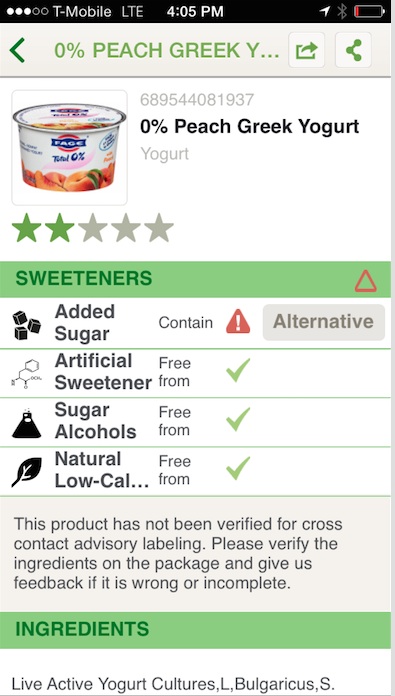
With one of the apps, SugerChecked, users scan a product to see if it fits into their personal sweetener preferences. They can tell the app to warn them if a product contains added sugar, an artificial sweetener, natural sweeteners or sugar alcohols.
Another app, MigraineChecked, takes a similar approach by identifying foods that contain ingredients that are known to trigger headaches in some people.
The ContentChecked apps can be customized to fit the users personal dietary profile and they can also help those who prepare food for people who have sugar restrictions or food allergies.
All of the apps listed here are free and most are available for both Apple and Android mobile devices.
I believe that most people have the knowledge to create the type of life they want, they just don't have the perseverance to pursue their goals.
There are too many distractions in our daily lives. Dealing with work, family, children, money and other daily issues issues sap or energy and attention, leaving little time to devote to the thoughts and practices that bring us peace and happiness. Me time just boils down to sleep time.
A new app called My Perfect Day is designed to help us fallible human focus on things that are important to us while finding a measure of daily happiness.
The app is divided into four primary elements: Journaling, Breathing, Habits and Affirmations.
Journaling gets users' attention every morning and evening and guides them through a set of questions that focus on the things in their lives that bring them the highest level of happiness and overall fulfillment.
Breathing and Habits sections prompt users to pursue activities that contribute to their physical and emotional well being. Proper breathing routines can keep our bodies infused with fresh oxygen while Habits remind users to exercise, talk with partners or maintain an active social life.
And Affirmations deliver words of encouragement that keep users moving along their chosen path. Here's an example:
I am the architect of my life; I build its foundation and choose its contents.
The My Perfect Day app is scheduled to be released on May 1. The initial version will be for iPhones and other iOS devices. To get a closer look at the app, check the video below and visit the App Store preview.
You know about the Bucket List, right? It's a collection of those things you want to do, or places you want to visit, before you check out, expire or "kick the bucket."
The subtext of the list is that few people make much of an effort to realize their dreams until they're near the end. We all figure that we have plenty of time.
Well, here's and app that might change your mind.
Vitamean is a simple visual expression of your personal lifespan. It uses world population data compiled by the United Nations and tailors it to fit your profile. You enter some basic information -- your birth date, sex and home country -- then it calculates how many weeks you've lived and how many more you are likely to have before . . . you know.
To drive the point home, the app displays a cute animation of an hourglass sand clock. A gray blob at the bottom of the clock represents all of the weeks that have already passed by. The yellow blob above it represents the weeks ahead of you.
If you were born in the early 80s, the ends of clock will look fairly balanced. If you're collecting on Social Security, you'll see that time is, quite literally, running out.
If the image gets you thinking about your life and what's ahead of you, that's what the people who made the app had in mind. They put it this way: "We hope the visualization of this data will motivate people to make positive changes in their lives."
iOS users can download Vitamean for free in the Apple App Store.
Back in my teen age years, I thought it would be a great idea to quietly listen to my favorite radio stations in bed. For a couple of dollars, I bought disc-shaped speaker that plugged into the headphone jack on my transistor radio. The setup worked fine, but it had unintended consequences: Instead of keeping me entertained deep into the night, it quickly put me to sleep.
Years later, I remembered that little pillow speaker when I was offered a free sample in exchange for a review of the Q-Sleep Soundwave Sleep-promoting pillow. This is a high-tech system that goes way beyond that cheap speaker that attached to my radio. It includes both a foam pillow and a mobile app that plays soothing music to lull you to sleep and records your sleeping habits.
I thought I would be a perfect candidate to try the Q-Sleep system. I’ve been diagnosed with sleep apnea. I snore (or so I’m told). And, I occasionally trouble falling asleep. That’s probably because I often do what sleep experts tell you to avoid if you want a good night’s rest - I turn on my mobile phone and start browsing the news and social media. Although my body is tired, my brain is soon filled with new information and that’s not a healthy combination.
The Q-Sleep pillow and I got off to a great start. The pillow measures about 12 by 22 inches in a wedge shape. The actual pillow is a sculpted piece of foam material encased in a soft fabric cover. The cover has a zipper that allows you to remove the foam before laundering the case and the underside has a grommet that lets an audio cable and plug emerge
The first thing I noticed was the soft and pleasant feel of the cover. I could rub my hand over the surface without encountering any snags on my rough skin. I considered putting the pillow inside a standard pillowcase, but I liked the feel of Q-Sleep fabric better than anything in my bedding drawer. Just touching the pillow was a relaxing experience.
Getting the pillow to work with the Q-Sleep app daunting and complicated experience that started with poorly-written instructions written in tiny type on a tiny folded card I found inside the pillow box. The instructions directed me to download the Q-Sleep app from either the Apple iTunes Store or the Google Play Store.
The app was easy enough to find and install but getting it working was a nightmare. The app requires registration with an email address and password but never explains why that’s necessary. It also requires that your email address be confirmed by responding to an email sent by Q-Sleep. That email never arrived.
After several failed login attempts, I tried the “Forgot password” option which produced a screen asking for a phone number to receive a text message. My phone numbers were repeatedly rejected and I was later informed that Q-Sleep did not actually have the capability to send a text message in the US.
I switched to a different phone and a different email address and finally got a confirmation message. It was written entirely in Chinese, except for the confirmation link, so I was eventually cleared to use the app on my iPhone 6. I have the app on my iPhone 7, but it has no audio jack. I would have to use a Apple converter dongle and those things are notoriously easy to loose and expensive to replace.
Now that I was registered and had access to the Q-Sleep app, it was time for bed. The app displays a large round button where you a long press launches the sleep recorder. The bottom of the screen presents my options for bedtime music. There were dozens of selections available, but all the descriptions were in Chinese, except for a few graphics with English words, one of them offering music from Plants vs. Zombies.
I connected the cable to the phone’s headphone jack, selected one of the music options and pressed my ear to the pillow. Silence. I fiddled with the cable plug and heard some faint crackling noise. I turned the sound up to full volume and heard some soft, soothing music sounding as if it were being played far away.
And that’s just what I needed. Back in the days with my portable radio, I wanted to hear a disk jockey’s patter from Chicago or St. Louis. Now I wanted quiet music with no voices to help me drift off and that’s just what I got. I was asleep in less than five minutes. The app lets you set the music music to shut off after 10, 20, 30 or 60 minutes. There appears to be a fifth setting but it’s in Chinese, so don’t know what it does.
In the morning, I awoke feeling rested and refreshed. The phone was still connected to the pillow and had used about 25 percent of its battery power. The app’s Sleep Health report gave my sleep a rating of 72 percent or Ordinary - the middle spot between Excellent and Improve. It said slept for 7.4 hours, split almost equally between deep sleep and light sleep. I took that as a passing grade.
There are many elements in the Q-Sleep system that need improvement. A functioning registration process and labels written in English would be a good start. Even the text that is nominally in English is often indecipherable. Here’s an example from one of the app’s introduction screens:
Warm tip: before opening monitoring please ensure clear enjoy APP allowSend notification (in settings - notification management view)
In the end, the Q-Sleep system did what it promised to do. It analyzed and scored my sleep quality and, more importantly, it provided a comfortable place to put my head while it transported me peacefully off to dreamland. This pillow and I are going to be spending many nights together.
The Internet is loaded with medical information but it’s not easy to separate unbiased and independent information from content that’s more like advertising for a company or a product.
Doctor Spring is a service designed to fill that gap. It offers users a fast online consultation with a doctor who is not trying to sell you something. Users submit a question along with a brief medical history and they get a response in a few hours.
Doctor Spring offers three levels of service. Users can get answers to simple medical problems from a certified family physician or general practitioner; consult with a specialist in areas such as oncology or cardiology; or get detailed reports from four specialists.
The service has more than 2,000 participating doctors covering 41 specialties. Prices for the service range from $18 for an answer to common problems to as much as $59 a month for the group reports with unlimited consults and follow-ups.
For more details and to read profiles of the doctors, visit the Doctor Spring website.
According to government reports, about one out of every six people aged 14 to 49 years have genital herpes. And while herpes can be easily managed and often presents no visible symptoms, it can be a worrisome issue for single people who are looking for dating partners.
An app called MPWH - Meet People With Herpes - has created a special community that brings together only people with genital or oral herpes.
The app has the same features as other popular dating apps. Members can not only browse listings and send winks or messages, they can also swipe to add favorites or eliminate listings with a feature called Spark.
They can also see who has viewed their profile and shape photos, words or comments that might help attract interested parties. Privacy settings allow users to hide their profile, show it only to heir favorites and can check someone’s profile anonymously.
MPWH also says it will remove an account from the app if it finds that the owner is not living with Herpes.
The app can be downloaded for free in the iTunes App Store and from the Google Play Store. Membership fees range from 1 month subscription with auto renewal: $33.99 to one month to $109.99 for six months.
Those voices in my head? They’re not signals from space or instructions from the CIA. More likely, it’s probably my wife calling with dinner plans, the folks on the Freakonomics podcast, or a song from my James McMurtry playlist.
And although the sound arrives over a Bluetooth channel, it’s not coming through headphones, it's piped into my ears through hearing aids.
Yes, I’m one of the estimated 30 million Americans who have some level of hearing loss. I blame mine on years of loud rock ’n roll concerts.
Wearing hearing aids make headphones problematic: there's no room for earbuds and over-the-ear pads can cause feedback and muffle nearby sounds, some of them potentially dangerous. Why, I often wondered, haven’t the brainiacs in the electronics industry come up with a way to build Bluetooth technology into hearing aids?
That marriage finally took place a couple of years ago. Now there are several medical-grade hearing aids that that can be controlled and customized from a mobile app and deliver streaming audio. For the past two months, I’ve worn a pair of Halo 2 hearing aids provided by Starkey Hearing Technologies, a Minnesota company with a 50-year history of making hearing aids. In 2014, Starkey launched a Made for iPhone hearing aid with a mobile app and streaming capability.
Earlier this month at CES, I checked out offerings from two other hearing aid makers: ReSound and Oticon. ReSound shares an ownership umbrella with Jabra headphones and Oticon was a pioneer in using digital processors in hearing aids.
Unlike the Bluetooth hearing boosters that are sold through retail outlets, the Starkey, ReSound and Oticon aids are meant to be provided by an audiologist, a licensed dispenser or a doctor. When I got the Halo 2 aids, they came with professional assistance that included a hearing check and specific tuning for my personal hearing profile.
But once the devices were in place, I could use a Starkey app called TruLink to control the devices. The app will raise or lower volume levels or cycle through default settings for different listening environments such as a restaurant, a car or for music.
Custom settings can also be created and stored as Memories for additional situations. For example, I might want a very wide and sensitive setting for a quiet walk in the woods, or one that focuses on the voice that is closest to me. That’s helpful at a party or public event.
A few days ago, I used the app to focus on the speaker at the a business conference. He was standing at a podium about 30 feet away at the front of the room. I heard an immediate improvement. Another way to tune in to a speaker or a conversation is to turn the iPhone into a remote microphone. At a group dinner at a noisy restaurant, I put my phone closer to my wife, who was sitting two seats away. That trick worked pretty well, though I wasn’t thrilled about putting my phone out of reach.
The sound amplification I get with the Halo 2 is as good and often better than my experience with the digital hearing aids that I bought a few years ago. I’ve had fewer situations where I’m unsure of the direction a sound is coming from or straining to adequately hear a someone who speaks softly.
Starkey says their aids incorporate technology that tackle both of those issues. It automatically compresses frequencies that are not usually generated with speech, and it says the Halo 2 aids communicate better with each other, which helps the wearer more easily identify the direction a sound is coming from.
The Bluetooth streaming has been an added bonus. My iPhone 7 paired smoothly with the hearing aids using the Accessibility option for hearing devices. Now Hearing Aids appears as a listening option when I get a phone call, play music, watch a video or listen to an audio book or podcast. I’ve had a few complaints from callers who said they couldn’t hear me very well when I’m talking through the hearing aids, but most people couldn’t tell any difference.
One feature on my Bluetooth headphones that I sometimes miss is the ability to accept an incoming call by pressing a button on one of the ear pads. The Halo hearing aids don’t have a similar button, but they do cooperate nicely with the Apple Watch, so I can accept a call by tapping my wrist.
The TruLink app has an extension for the watch, but its feature list is pretty short. I can cycle through the Memories settings or adjust the hearing aid volume, but only if the companion app on the phone is open.
ReSound LiNX2
ReSound and Oticon have also linked their smart hearing aids to mobile apps and other accessory devices. The ReSound Smart app is available for both Apple and Android devices and the iOS version works with the Apple Watch.
The app contains default settings for different environments, including restaurants or outdoors, and it allows users to create and store custom settings. It will also help users find misplaced hearing aids.
Other ReSound accessories include two wireless microphones. One is a clip-on mic that you would give to a family member, teacher or anyone you want to hear clearly. The other is a multi-directional mic that you might place on a table to tune in a group of people. ReSound also makes a streaming box that can be connected to a TV set or music source.
Like the other hearing aid apps, Oticon’s ON app for Apple devices will control volume levels and switch settings for its Opn model hearing aids. It also helps find lost hearing aids and it offers some controls through the Apple Watch.
Oticon Opn
But Oticon dives a bit deeper into the Internet of Things, the networks that that link everything from light switches to kitchen appliances. Oticon says its Opn model is the first hearing aid that will also interact with smart home devices such doorbells, thermostats and security systems.
The Opn hearing aid supports connections made through an Internet service called IFTTT (If This Then That) where users create simple scripts to send orders to smart devices.
For example if an event occurs (someone rings the doorbell or a smoke detector goes off), that triggers a response (a verbal message to your hearing aids or a text alert to a caregiver).
The IFTTT option is one more step toward a good example of how modern hearing aids are evolving well beyond the tiny amplifiers that our grandparents wore. Today they are miniature computers that keep us plugged into the digital world around us.
Innovation in the consumer electronics industry follows a predictable pattern. A company develops a new and innovative product like a smartphone or portable music player, and sells scads of them at high prices.
But the new gadgets soon get competition from lower-priced alternatives that expand the market and drive down prices. I remember when the first DVD players cost almost $1,000. Now, you can buy one for less than $50.
There’s a similar cycle at work in the world of pharmaceuticals and health supplements. In the 1990s, scientists at Pfizer discovered sildenafil as a treatment for erectile dysfunction. Sold under the brand name Viagra, the drug quickly created a booming demand for male enhancement products.
Today you can find comparisons of a variety of products designed to “assist in improving erections in men, semen production, and overall performance” on websites like OMG Brah!. The site's Featured products include VigRX Plus, Maile Extra and ExtenZe.
While OMG Brah! doesn't sell the products, it offers links to sites that do and all of the featured products can be ordered for under $100 - far less than the cost of their brand-name prescription competition.
I’m hoping that a similar product cycle will take hold in the electric car industry. I’m ready for an alternative to my gas-slurping vehicle - I just don’t want to pay the price of a Tesla.
Judging by the number of products promoted online, you might conclude that men face a barrage of health issues as they grow older.
Websites and online ads offer treatments for a variety of ailments from hair loss to erectile dysfunction.
But do these products actually work? I don’t have the answer but a website called Mens Review Zone says it offers honest and unbiased reviews of those types of treatments.
When I checked the site, it listed articles about the iGrow laser therapy device for hair growth, a muscle-building supplement called Nitrocut, Optimind pills for enhanced memory and energy and a testosterone booster called Oral Testibol.
Mens Review Zone says its reviews are written by actual users, including their own team. Readers are also encouraged to post their own comments on the reviews.
If you’re familiar with the TV show The Biggest Loser, you’ll remember that one of the central elements of their weight-loss program was a controlled diet with healthy meals provided in specific portions.
But the dramatic focus of the show was the weekly weigh-in. Tracking how many pounds the contestants were able to shed not only kept the scores in the race to the big payoff, it also helped reward the participants for their efforts and motivate them to do better in the week ahead.
People hoping to lose weight without going on national TV are turning to home-delivery food services like BistroMD. The service provides gourmet-type meals that are designed by dietitians and prepared by chefs. A review posted
A review posted on the diet and fitness blog FIT.I.J highlights notes that the service offers dishes with intriguing names like Berry Crepes and Moroccan Inspired Chicken. The monthly fee for the service includes free shipping.
A good companion for a diet based on BistroMD meals is the Weight Loss Tracker app for Android devices. The app is a body weight diary that provides graphical statistics on your body weight improvements. The app will also comment on your progress and achievements and continuously encourage you to improve.
The app also includes a Body Mass Index calculator that will display a graphical interpretation of your current condition and let you know if you are overweight, underweight or have normal weight for your age and height.
The app is available as a free download in the Google Play Store.
My diet counsellor is my wife and she tries hard to warn me away from sweet and salty snacks, but she’s no match for food management services like Diet-to-Go.
The service provides low-calorie meals that are delivered to your door or you can pick them up in five major cities including Washington, Philadelphia, Los Angeles and San Francisco.
The foods are based on different meal plans designed to meet specific goals. For example, there’s a low-carb plan, a vegetarian plan and a low-fat plan. The foods are prepared by Diet to Go (unlike some other delivery plans that use packaged foods) and the company says it follows the American Diabetes Association Guidelines.
Many of the positive reviews that Diet to Go gets are posted at the FIT.I.J website run by a self-described fitness buff who believes that staying physically fit is a key element in the wealth equation.
In addition to reviews, the site includes a blog that tracks news from the diet and fitness industry and FIT.I.J offers discount coupons for Diet to Go members.
Anyone who gets serious about a weight-loss program knows they have to start out by logging their current weight and setting a target weight. That’s why the TV show The Biggest Loser would do all those weigh-ins.
An app called Monitor Your Weight lets you track your progress - and set-backs - and provide a snapshot view on your phone or tablet.
The app will suggest an ideal weight based on your current weight, height, body frame, gender and age. Then it recommends the amount of time needed to reach. You can accept that plan to customize it to suit your own needs and plans.
As you enter your current weight as regular intervals, the app calculates statistics and creates graphs that show you how you’re doing. It supports multiple profiles, so you can monitor the progress of friends or family members launch a friendly competition like the ones in the TV show.
The stats produced by Monitor Your Weight include body fat percentage, average daily or weekly weight loss ad daily calorie intake. The app also works with different measurements from pounds and kilos to stones.
Monitor Your Weight is available as a free download for Android devices in the Google Play Store. To help with any weight-loss plan, check out the Spiqy website for health and nutrition tips and product reviews.
I started reporting on gadgets and gear when Atari ruled electronic games and computers used floppy disks. My weekly column ran in the The Louisville Courier-Journal and online at USAToday.com and ABC News.com. I was a regular at tech trade shows including COMDEX, CES and the CEDIA show for home theater. Follow @GizmoEditor on Twitter and on Facebook. Contact me at ricman@iglou.comI also create short videos for vendors to use on Amazon and YouTube. Click here to see a portfolio of my recent videos.
Video by Gizmo
Need a video to promote your app or product? Check out my gig at Fiverr.com and browse my video portfolio here.





 Posts
Posts


